


By hearing the name a picture might have popped in your mind where a person sitting high up at the peak of a hill is operating a computer just very near to the periphery of a normal fluffy white typical cloud. Well if you might have thought of it then, congratulations! you have just stepped on the basic step of understanding this technology.Well this is not exactly the case but further you will get to know about it as you read further.
Why the name cloud?
Since from the primary school we all are aware that normal cloud is a cluster of water vapours floating high up in the air and obviously is not stationary i.e. it keeps on hovering. Similarly a computing cloud is a dense cluster of computers working together in such way that to a normal observer they all appear to be one giant computing resource.So in short this is about the cloud stuff. These cloud computers include servers,storage,networking applications and services that can be easily and rapidly provisioned and released.

Where on Earth is this cloud computer actually located?
Cloud Computers are located at what is known as cloud campus. Cloud campus is our term for the sites where technology titans concentrate massive amounts of computing power in multiple data center facilities. These huge campuses are where the cloud lives – the physical manifestation of the Internet, often located in rural areas offering cheap land and power. So to access this service of cloud computing these campuses lend us their service to access this technology right from where we are sitting at any instant of time, thanks to the internet of things. YEP YEP told you that you don’t need to take your computer at hilltop.
Essential characteristics of cloud computing system
- On demand self service:-This allows users to quickly and automatically get access to the I.T. resources that they want without requiring any additional human interaction.
- Broad Network Access:-This is the ability to access a service from any standard device that’s connected to the network including PCs, laptops,phones or tablets.
- Resource Pooling:- Computer network and storage are pooled and shared across multiple customers.
- Rapid elasticity:-This allows you to quickly scale or shrink the capabilities of your service to match the level of user demand.
- Metering:-This tracks and controls the level of resources usage or the cost of that usage.

Options provided while accessing to cloud service
On the basis of your demand and workload cloud services provide the following options to match your demand at its best. There are basically three options which are
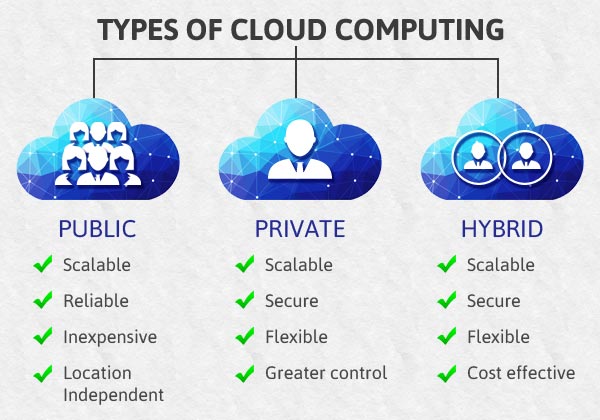
- Private Cloud Service:-This is provisioned for exclusive use of a single organisation. The infrastructure of cloud is managed and operated within its own firewall(used to prevent unauthorised access to a private network).
- Public Cloud Service:- This is open for use by the general public.This type of cloud is owned and managed by the service producer and runs on the provider’s premises.
- Hybrid Cloud Service:-This allows a user to access both private and public cloud resources from a single management environment.
Technical services offered by the cloud
There are three distinct type of I.T. services available today through private,public & hybrid cloud.
- SaaS (Software As A service):- SaaS allows users to access an application without having to manage or control the underlying cloud infrastructure. An examples is G Mail.
- PaaS (Platform As A Service):- PaaS allows users to access to a software development environment to allow them to create their own cloud applications using programming languages and services & tools .The user has control over these applications without having to manage or control the underlying cloud infrastructure. An example is Amazon(not shopping site).
- IaaS (Infrastructure As A Service):- IaaS is the most widely viewed as a cloud service.It allows a user to quickly and easily provision full computing resource including processing,storage & networks without the user having to manage or control the cloud infrastructure.

3 reasons why cloud computing is gaining popularity
- Scalability:- On the basis of your demand if you need 10 or more servers , you can easily grow or shrink the number based on what you need now.
- Instantaneous Service:- The computing power is there when you need it , you just turn it ON whatever you need is instantly available in the cloud & when your need goes down you can simply turn them OFF.
- Money Saving:- You only pay for what you use and and not for equipment around just in case you might need it.
Daily examples of cloud computing
Cloud computers have already taken an edge in people’s lives and it’s impact is growing day by day. It’ daily usage includes
- Cloud Storage servers like Gmail,Google drive , Dropbox and even Facebook too.These provide storage servers to store data online which can accessed on multiple devices.
- Cloud computing in healthcare is a major boost for efficiency. It lets nurses, physicians, and administrators share information quickly from anywhere. It also ensures patients receive the best possible care without unnecessary delay. The patient’s condition can also be updated in seconds through remote conferencing.
- Cloud computing in education has boosted the concept of open schooling. Students can build presentation and can submit them through web conferencing all on the cloud.

Advantages and Disadvantages
Since a coin has two side likely a new technology has its merits and demerits too. Till now we are quite acquainted with it’s advantages like reliability, money and power saving factor, instancy etc. About its disadvantages it is
- Downtime:- As cloud service providers take care of a number of clients each day, they can become overwhelmed and may even come up against technical outages.
- Security:-Although cloud service providers implement the best security standards and industry certifications, storing data and important files on external service providers always opens up risks.
- Limited Control:- Since the cloud infrastructure is entirely owned, managed and monitored by the service provider, it transfers minimal control over to the customer. The customer can only control and manage the applications, data and services operated on top of that, not the back end infrastructure itself.
Conclusion
A matter of concern is that this technology is still a part of research and many more efficient ways are being discovered to extract its full usage ,this technology will soon replace the modern computer infrastructure to manage and process data.

“Cloud is about how you do computing, not where you do computing”
keep sharing, keep promoting, thank you for scrolling till end
 The Popcorn thoughts
Hmmm this blog !!.
It’s having tremendous amount of knowledge .
Read it to the last page !
Loved it !!
LikeLiked by 1 person
Kudos to the streak !!!
LikeLike
Very well.
LikeLiked by 1 person
Thank you 😁
LikeLike
Very well pointed and detailed information with easy to understand wording. Keep it up
LikeLiked by 1 person
Thank you so much…. I hope you found it useful
LikeLike
Hey man !! You nailed it again !! Keep going
LikeLike
Good info..
Well explained…
Good going…!!!
LikeLike
Well done Anurag .
LikeLike